
The University of Digital and AI Management (UniDAIM) has officially launched its AI Governance Framework, establishing a structured approach to the responsible, transparent, and accountable use of artificial intelligence across the University.
As an institution focused on digital and AI management, UniDAIM recognizes that effective AI adoption requires more than technological capability. It requires clear principles, appropriate oversight, risk management, and continuous review. The new framework brings these elements together in five interconnected components.
1. AI Governance Principles
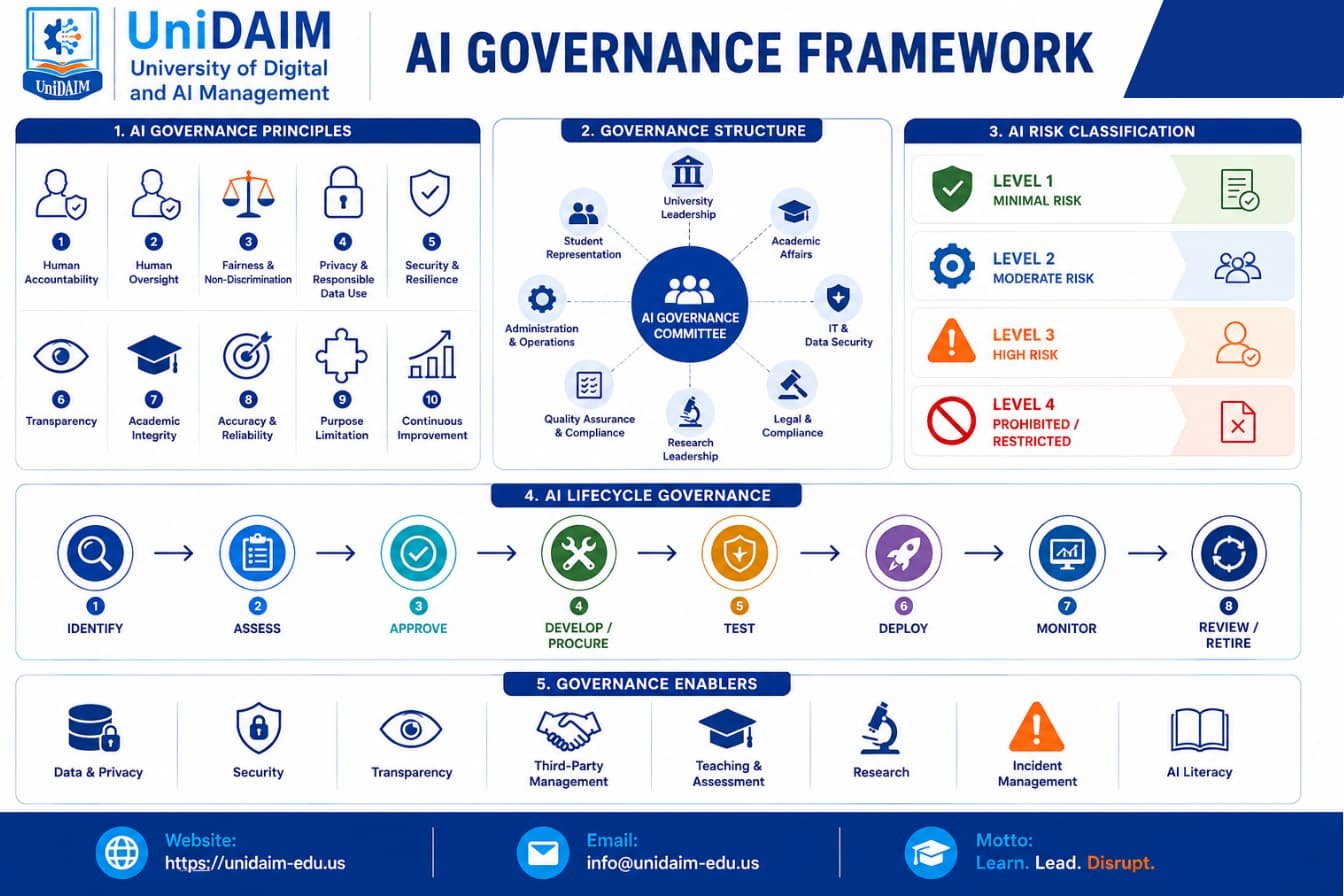
The foundation of the framework is a set of 10 governance principles covering human accountability, human oversight, fairness and non-discrimination, privacy and responsible data use, security and resilience, transparency, academic integrity, accuracy and reliability, purpose limitation, and continuous improvement.
Together, these principles establish the standards that guide how AI should be used across UniDAIM.
2. Governance Structure
The second component establishes clear roles and accountability for AI governance. At its center is the AI Governance Committee (AIGC), supported by University leadership, academic affairs, IT and data security, research leadership, legal and compliance, quality assurance, administration, and student representation.
AI System Owners are also responsible for overseeing individual AI systems throughout their lifecycle.
3. AI Risk Classification
Not every AI application carries the same level of risk. UniDAIM therefore adopts a four-level risk classification: Minimal Risk, Moderate Risk, High Risk, and Prohibited/Restricted.
This risk-based approach ensures that higher-impact AI applications receive stronger assessment, approval, monitoring, and human oversight.
4. AI Lifecycle Governance
The framework governs AI throughout its complete lifecycle: Identify → Assess → Approve → Develop/Procure → Test → Deploy → Monitor → Review/Retire.
This ensures that governance is not treated as a one-time approval but as an ongoing process from the initial idea through deployment and eventual retirement.
5. Governance Enablers
The final component brings together the practical areas that support responsible AI implementation: Data & Privacy, Security, Transparency, Third-Party Management, Teaching & Assessment, Research, Incident Management, and AI Literacy.
These enablers help translate UniDAIM’s governance principles into everyday institutional practice.
Advancing AI Responsibly
Through the launch of this framework, UniDAIM strengthens its commitment to using AI to expand human capability while preserving human responsibility, academic integrity, institutional trust, privacy, security, and accountability.
The framework will continue to evolve alongside developments in AI technology, international standards, regulatory requirements, and emerging risks.
Explore the AI Governance Framework
SHARE