
A traditional doctoral program is not the only route to earning a doctoral qualification.
Some universities recognize that years of professional leadership, innovation, research, and industry contributions can demonstrate learning equivalent to doctoral-level outcomes.
Rather than repeating in the classroom what you’ve already learned through professional experience, the assessment evaluates your existing doctoral-level competence.
This guide explains how a Doctoral Degree with Work Experience works and walks you through the six steps involved in the assessment process at the University of Digital and AI Management (UniDAIM).
What is a Doctoral Degree with Work Experience?
A doctoral degree with work experience is an academic pathway that recognizes doctoral-level expertise, leadership, and professional achievements gained through extensive practical experience rather than a traditional doctoral program.
Instead of attending classes and completing a dissertation, eligible candidates demonstrate their competence by submitting a portfolio of work supported by verified evidence of their professional accomplishments.
At UniDAIM, this pathway operates through the Validation of Acquired Experience (VAE) framework.
Under this model, your portfolio of work is assessed against the learning outcomes of the relevant doctoral degree program.
The evaluation is conducted by the VAE Assessment Committee, comprising scholars and industry practitioners. Where the required academic standards are met, the committee may recommend the award of a doctoral degree.
The Doctoral Degree with Work Experience pathway at UniDAIM has the following features:
- 100% online
- No classes or lectures
- Completion within 1–4 weeks after submission of a complete application
- One-time administrative fee of $2,000 upon approval
How to Get a Doctoral Degree with Work Experience
While procedures vary among institutions, most experiential learning programs follow a structured academic assessment process rather than traditional classroom study.
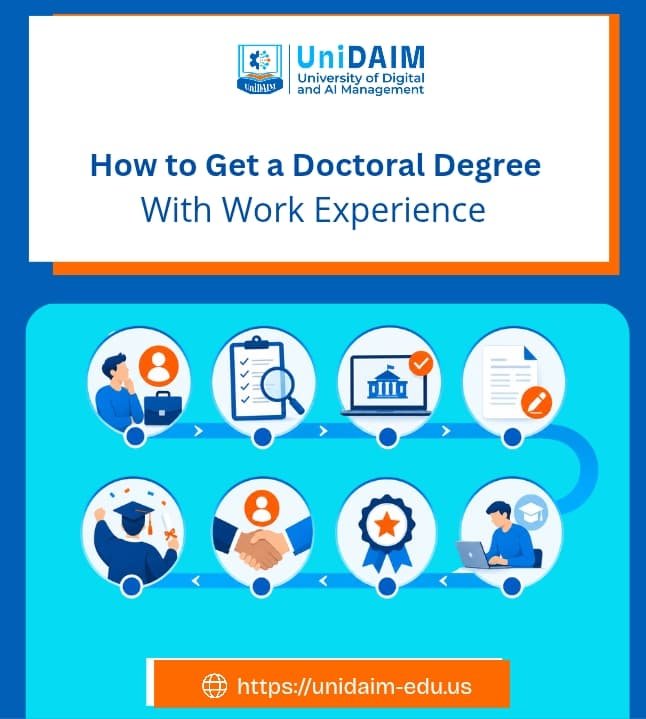
At UniDAIM, the Doctoral Degree with Work Experience pathway consists of six stages.
Step 1: Meet the Requirements
Before beginning your application, make sure you satisfy the minimum eligibility criteria.
At UniDAIM, applicants are generally expected to have:
- A master’s degree or equivalent qualification in the desired or related field
- A minimum of ten (10) years of relevant professional experience with demonstrable outcomes
- A portfolio of work demonstrating doctoral-level competence
- A suitability statement of at least 500 words explaining why your experience qualifies you for assessment
Although not compulsory, letters of recommendation from respected professionals or senior colleagues can strengthen your application by providing independent evidence of your leadership, expertise, professional impact, and contributions to your field.
Step 2: Apply Online
The next step is submitting the online application together with all required supporting documents.
These typically include:
- Curriculum Vitae (CV)
- Professional portfolio
- Academic certificates and transcripts
- Suitability statement
Depending on your profession, your portfolio may include research, publications, leadership achievements, strategic projects, patents, awards, certifications, or other documented evidence demonstrating doctoral-level competence.
Providing well-organized, verifiable evidence allows the assessment committee to evaluate the depth, originality, and significance of your professional learning.
Step 3: Undergo Academic Assessment
After your application has been submitted, it enters the academic evaluation stage.
At UniDAIM, the VAE Assessment Committee carefully reviews your portfolio to determine whether your experiential learning aligns with the learning outcomes of your chosen doctoral degree.
During the assessment, the committee considers several important factors, including:
- Depth of professional knowledge
- Years of relevant experience
- Leadership responsibilities
- Complexity of projects completed
- Original contributions to the profession
- Research, innovation, or strategic impact
- Industry recognition
- Overall evidence of doctoral-level competence
Step 4: Receive Your Assessment Outcome
Once the evaluation has been completed, you will receive a formal assessment report outlining the committee’s findings.
If your portfolio demonstrates the required doctoral-level competencies, the committee may recommend you for the award of the degree.
Where certain learning outcomes have not yet been fully demonstrated, the committee may recommend additional evidence, competency requirements, or academic work before final approval can be granted.
Step 5: Pay the Admin Fee
If your application is approved, the next step is to complete the one-time administrative fee payment.
Our Doctoral Degree with Work Experience pathway requires a one-time administrative fee of $2,000. Installment payment options are available upon request.
Once the administrative fee has been paid in full, the university proceeds with the final stages of the award process.
Step 6: Receive Your Doctoral Degree
After all academic and administrative requirements have been satisfied, UniDAIM issues your verifiable doctoral degree diploma together with your academic transcript.
With your consent, the university may also announce your graduation and feature your profile on its Alumni page, recognizing your achievement and celebrating your professional journey.

What Fields are Eligible?
Not every profession is equally suited to experiential learning assessment.
This pathway is generally intended for disciplines where advanced expertise can be demonstrated through leadership, innovation, research, strategic decision-making, technical excellence, or measurable professional impact.
Examples of eligible fields at UniDAIM include:
- Business
- Management
- Public Administration
- Accounting
- Finance
- Economics
- Artificial Intelligence
- Data Science
- Computer Science
- Cybersecurity
- Digital Marketing
- Education
- Healthcare Management
- Information Technology
- Engineering
- Criminal Justice
- Environmental Management
- More than 50 additional disciplines
Professionals from related fields may also be considered where their experience clearly aligns with the intended doctoral degree program.
Why a Doctoral Degree with Work Experience?
For experienced professionals who have already demonstrated exceptional expertise throughout their careers, this pathway offers several benefits.
- Recognition of Professional Excellence: Rather than repeating knowledge you have already mastered, your existing expertise is evaluated for formal academic recognition.
- Career Advancement: A doctoral degree can strengthen your qualifications for executive leadership, consultancy, university teaching, board appointments, research leadership, and senior professional roles.
- Enhanced Professional Credibility: Combining extensive professional experience with a recognized doctoral qualification can further strengthen your reputation within your industry and beyond.
- Flexible Assessment Process: The assessment is completed remotely, allowing you to continue your professional responsibilities while your portfolio is evaluated.
- Recognition of Real-World Learning: Knowledge is not acquired only in classrooms. Years of leading organizations, solving complex problems, conducting applied research, and delivering measurable results can represent learning at the doctoral level when supported by credible evidence.
- Doctoral Title: Earn the “Dr.” title upon the award of an eligible doctoral degree, enhancing your professional credibility and recognition.
Who Should Consider a Doctoral Degree with Work Experience?
This pathway is intended for experienced professionals whose careers already reflect doctoral-level expertise.
It is best suited to individuals who have demonstrated sustained leadership, advanced problem-solving, innovation, research, or significant professional impact supported by credible evidence.
Rather than developing new knowledge through coursework, the assessment recognizes learning gained through extensive professional practice.
If you prefer a research-based program with academic supervision and a dissertation, a traditional doctoral program is likely the more appropriate choice.
Common Misconceptions Debunked
Several misconceptions continue to surround doctoral degrees awarded through experiential learning. Here are some of the most common.
FAQs
Conclusion
Professional experience can represent years of advanced learning, leadership, and innovation.
For accomplished professionals, a Doctoral Degree with Work Experience offers a structured pathway to have those achievements assessed for formal academic recognition.
Rather than focusing on time spent in a classroom, the assessment evaluates the knowledge, expertise, and professional impact you have already developed throughout your career.
If your career demonstrates doctoral-level competence supported by substantial evidence, this pathway may provide the academic recognition your expertise deserves.
It is an opportunity to have your years of professional achievement formally recognized while building on the experience and leadership you have already earned.
Related Posts:
SHARE