
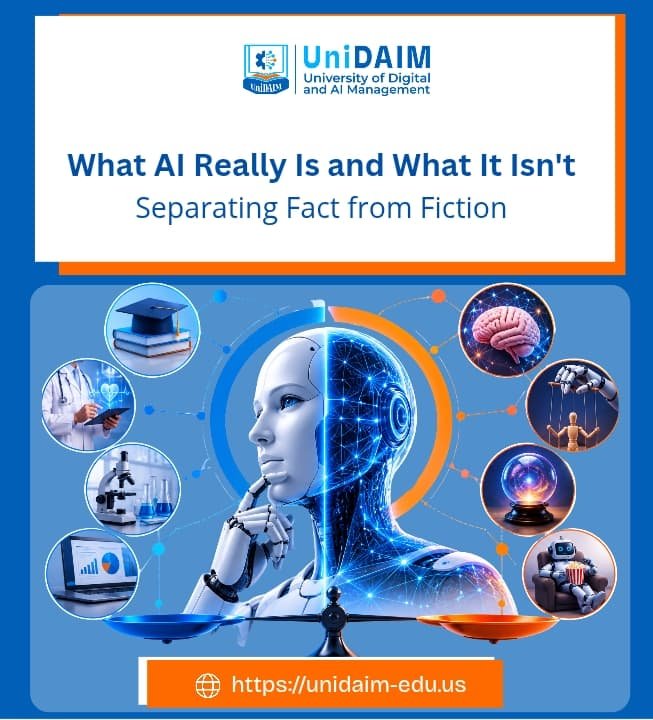
Artificial intelligence (AI) has become one of the most talked-about technologies of the 21st century.
It transforms healthcare, education, research, business, cybersecurity, and many aspects of modern life.
Yet, despite its growing presence, AI is also one of the most misunderstood technologies.
Popular culture often portrays AI as either a miracle solution or an existential threat, leaving many people uncertain about what it actually is.
Understanding AI begins with separating fact from fiction.
Whether you are a student, business leader, educator, policymaker, or lifelong learner, knowing what AI is—and what it isn’t—will help you use it more effectively and responsibly.
What Is Artificial Intelligence?
Artificial intelligence refers to computer systems designed to perform tasks that typically require human intelligence.
These tasks include learning from data, recognizing patterns, understanding language, making predictions, solving problems, generating content, and supporting decision-making.
Unlike traditional software, which follows fixed instructions, many AI systems learn from large amounts of data to improve their performance over time.
This allows them to adapt to new situations within the scope of the tasks they were designed to perform.
AI is not a single technology. It is a broad field that includes machine learning, deep learning, natural language processing, computer vision, robotics, speech recognition, recommendation systems, and generative AI.
What Is Generative AI?
Generative AI is a branch of artificial intelligence that creates new content rather than simply analyzing existing information.
It can produce text, images, videos, music, software code, presentations, and other forms of digital content based on prompts provided by users.
Popular examples include AI writing assistants, image generators, coding assistants, and conversational chatbots.
Generative AI has transformed how individuals and organizations create content, enabling faster drafting, brainstorming, editing, and ideation.
However, human judgment remains essential to ensure quality, accuracy, originality, and ethical use.
What AI Can Do
Modern AI can perform many valuable tasks, including:
These capabilities make AI a powerful productivity tool across education, healthcare, finance, manufacturing, government, research, and countless other industries.
What AI Is Not
While AI can perform many impressive tasks, it also has important limitations.
Recognizing these helps you use AI more effectively, responsibly, and with realistic expectations.
❌ AI Is Not Human Intelligence
AI can imitate certain aspects of human thinking, but it does not possess consciousness, emotions, intuition, or genuine understanding. It processes information mathematically rather than experiencing the world as people do.
❌ AI Does Not Know Everything
Although AI systems are trained on enormous datasets, they do not contain all human knowledge. They can produce incomplete, outdated, or incorrect information and should not be treated as infallible.
❌ AI Is Not Always Correct
AI can make mistakes, misunderstand questions, generate inaccurate information, or present false information confidently. Every important output should be verified, especially in medicine, law, finance, engineering, research, and education.
❌ AI Does Not Replace Human Judgment
AI supports decision-making, but it should not replace critical thinking. Humans remain responsible for evaluating evidence, considering ethics, understanding context, and making final decisions.
❌ AI Is Not Magic
AI is built by people using mathematics, algorithms, computing power, and data. It requires training, testing, monitoring, and continuous improvement. Successful AI systems are the result of careful engineering rather than magic.
❌ AI Is Not Independent
AI systems operate within the boundaries of their programming, training data, and user instructions. They do not set their own goals or act independently in the way humans do.
Common Myths About AI
AI is often misunderstood because of media hype, science fiction, and misinformation.
Understanding these common myths helps you separate fact from fiction and use AI more confidently and responsibly.
Myth 1: AI Will Replace Every Job
Reality: AI is changing work rather than eliminating all work. Many routine tasks are becoming automated, but new careers and opportunities continue to emerge. Professionals who learn to work effectively with AI are likely to remain highly valuable.
Myth 2: AI Thinks Like Humans
Reality: AI recognizes patterns and predicts likely outputs. It does not possess human consciousness, emotions, beliefs, or lived experiences.
Myth 3: AI Is Always Objective
Reality: AI reflects the quality of the data used to train it. If training data contains bias or errors, AI outputs may also reflect those issues.
Myth 4: AI Can Learn Anything Instantly
Reality: AI systems require training, evaluation, computing resources, and carefully prepared data. They cannot instantly master entirely new domains without appropriate development.
Myth 5: AI Makes Expertise Unnecessary
Reality: Experts remain essential. Lawyers, doctors, educators, engineers, researchers, designers, writers, and business leaders provide the context, ethics, creativity, and judgment that AI cannot replace.
Why Responsible AI Matters
As AI becomes more integrated into daily life, responsible use becomes increasingly important.
Organizations and individuals should use AI in ways that are ethical, transparent, fair, and accountable.
Responsible AI includes:
- Protecting privacy and personal data.
- Reducing bias and discrimination.
- Verifying AI-generated information.
- Respecting intellectual property and copyright.
- Being transparent when AI assists in content creation.
- Maintaining meaningful human oversight.
- Using AI to augment rather than replace human capabilities.
Responsible AI builds trust while ensuring technology benefits society.
Preparing for an AI-Driven Future
AI literacy is quickly becoming a foundational skill across industries.
Regardless of your profession, understanding AI can improve productivity, enhance decision-making, and create new opportunities.
To prepare for the future:
- Learn AI fundamentals.
- Develop strong prompt-writing skills.
- Practice verifying AI outputs.
- Understand AI ethics.
- Continue strengthening uniquely human skills such as creativity, empathy, leadership, collaboration, and critical thinking.
The most successful professionals will not be those who compete against AI, but those who learn how to collaborate with it effectively.
Conclusion
Artificial intelligence is neither a magical solution nor a substitute for human intelligence.
It is a powerful set of technologies that can help people work smarter, solve problems faster, and unlock new opportunities when used responsibly.
Understanding what AI is—and what it isn’t—is the first step toward becoming an informed and confident AI user.
By combining human expertise with responsible AI, individuals and organizations can achieve better outcomes while ensuring technology serves people, not the other way around.
At UniDAIM, we believe AI literacy should be accessible to everyone. By empowering learners with practical knowledge, ethical principles, and real-world skills, we prepare graduates to thrive in a future where humans and AI work together to create lasting value.
SHARE