
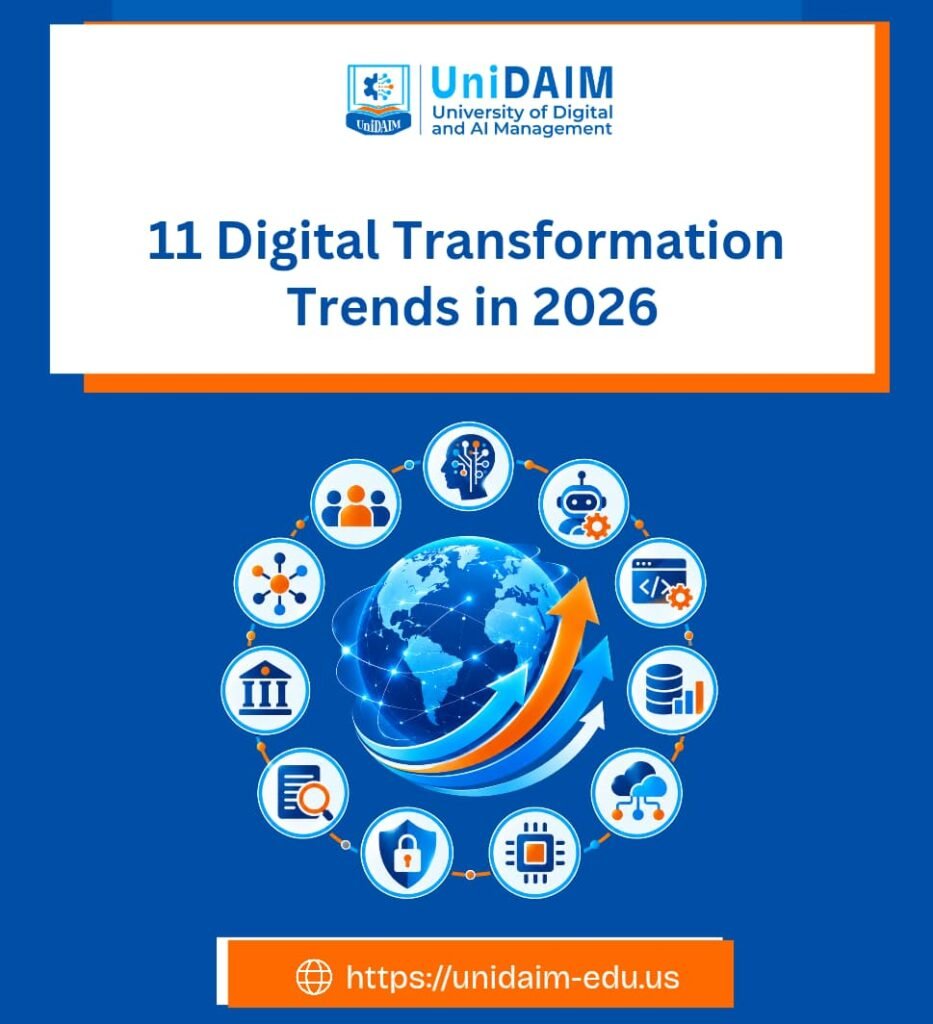
Digital transformation has entered a more demanding phase. For much of the past decade, organizations focused on moving services online, adopting cloud infrastructure, automating repetitive processes, and improving access to data. In 2026, those activities remain important, but they are no longer sufficient to define digital maturity.
The focus is shifting from adopting individual technologies to redesigning how organizations operate. Artificial intelligence, autonomous systems, advanced computing, cybersecurity, data platforms, and connected technologies are increasingly being combined within business processes.
The World Economic Forum describes this development as technology convergence: competitive advantage increasingly depends on an organization’s ability to integrate multiple technologies, people, data, and workflows rather than simply acquire new tools.
This report examines the major digital transformation trends shaping 2026 and the implications for organizations, technology leaders, and professionals.
- 1. Artificial Intelligence Becomes a Core Business Capability
- 2. Agentic AI Moves from Experimentation Toward Operations
- 3. AI-Native Software Development Changes the Technology Function
- 4. Data Architecture Becomes Central to AI Transformation
- 5. Hybrid Computing Gains Strategic Importance
- 6. AI Infrastructure and Specialized Computing Expand
- 7. Cybersecurity Moves Toward Proactive Defense
- 8. Digital Provenance and Trust Become More Important
- 9. AI Governance Becomes an Executive Responsibility
- 10. Technology Convergence Creates New Business Models
- 11. The Workforce Must Adapt to Human-AI Collaboration
- What Digital Transformation Leaders Should Prioritize in 2026
- Conclusion
- Sources:
1. Artificial Intelligence Becomes a Core Business Capability
Artificial intelligence is no longer being treated primarily as an experimental technology. It is becoming part of enterprise operating models, decision-making processes, customer services, software development, research, and internal operations.
McKinsey’s 2026 Global Tech Agenda reports that AI has become the leading technology investment priority among surveyed organizations, ahead of cybersecurity and infrastructure modernization. Half of respondents identify AI as a top investment area for the next two years.
The important change is not simply the number of organizations using AI. It is the movement from isolated applications toward AI embedded in core workflows. Companies are using AI to analyze information, support decisions, generate content, write software, assist employees, forecast demand, and interact with customers.
This creates a new management requirement. Organizations must determine where AI creates measurable value, what decisions should remain under human control, what data can be used, and how AI-generated outputs will be reviewed.
2. Agentic AI Moves from Experimentation Toward Operations
Generative AI introduced organizations to systems capable of producing text, images, code, and analysis. The next development is agentic AI: systems capable of pursuing defined objectives through multiple steps, using tools, accessing information, and executing portions of a workflow with limited human intervention.
McKinsey reports that leading organizations are increasing investment in agentic AI systems designed to plan, decide, and act across workflows. IBM’s 2026 technology research similarly identifies the move toward large-scale deployment of AI agents as a major architectural challenge for CIOs and CTOs.
Agentic AI could affect areas such as procurement, customer support, finance, compliance, software development, research, and business operations.
However, autonomy introduces a different risk profile from conventional software. An AI agent can make decisions, call external services, modify information, or initiate actions. Organizations therefore need clearly defined permissions, monitoring, audit trails, escalation mechanisms, and human oversight.
3. AI-Native Software Development Changes the Technology Function
Software development is also being reshaped by AI. AI-native development platforms can assist with coding, testing, documentation, application design, and maintenance.
Gartner identifies AI-native development platforms as one of its strategic technology trends for 2026 and projects that AI augmentation could eventually enable organizations to operate with smaller, more flexible software teams.
This does not eliminate the need for software professionals. Instead, the nature of their work is changing. Developers increasingly need to understand architecture, security, data, AI systems, product requirements, and governance alongside traditional programming.
The result is a broader shift from writing every component manually toward directing, validating, integrating, and governing software produced with AI assistance.
4. Data Architecture Becomes Central to AI Transformation
AI performance depends heavily on the quality, accessibility, security, and context of organizational data. As businesses move beyond experimentation, data architecture is becoming a central component of digital transformation strategy.
Deloitte’s 2026 State of AI in the Enterprise research emphasizes the importance of unified data strategies, modular platforms, domain-owned data products, privacy, security, interoperability, and data lineage.
This means organizations cannot treat AI as an independent technology project. Customer records, operational databases, documents, analytics systems, and external information must be connected appropriately while maintaining controls over access and quality.
Data governance is consequently becoming an operational discipline rather than simply an IT responsibility.
5. Hybrid Computing Gains Strategic Importance
The economics of AI are changing infrastructure decisions. Large-scale AI workloads require substantial computing capacity, and organizations are increasingly evaluating where workloads should run rather than assuming that every application belongs entirely in the public cloud.
Deloitte’s 2026 Tech Trends report describes a movement toward strategic hybrid architectures, combining cloud infrastructure with on-premises systems and edge computing according to requirements for elasticity, consistency, cost, and speed.
This approach is particularly relevant for organizations managing sensitive information, high-volume workloads, regulatory requirements, or applications requiring rapid local processing.
The infrastructure question in 2026 is therefore less about choosing between cloud and on-premises computing and more about designing the appropriate combination for each workload.
6. AI Infrastructure and Specialized Computing Expand
The growth of AI is also increasing demand for specialized computing. Conventional computing architectures are being supplemented by GPUs, AI accelerators, specialized processors, high-performance networking, and other technologies designed for intensive AI workloads.
Gartner identifies AI supercomputing platforms as a major strategic technology trend for 2026. The firm expects hybrid computing architectures to become increasingly important as organizations combine different forms of computing to handle complex workloads.
For business leaders, this reinforces an important principle: AI strategy is partly an infrastructure strategy. Model selection, computing costs, latency, data movement, energy consumption, and scalability all affect the economics of digital transformation.
7. Cybersecurity Moves Toward Proactive Defense

Digital transformation expands the number of systems, devices, applications, identities, and data sources that organizations must protect. AI is simultaneously strengthening defensive capabilities and providing attackers with new methods of automation.
Deloitte describes this as a central AI security challenge, noting that organizations need to secure AI across data, models, applications, and infrastructure while also using AI-enabled defenses against increasingly automated threats.
Gartner’s 2026 technology outlook similarly highlights preemptive cybersecurity, with organizations moving toward approaches designed to identify and disrupt threats before conventional attacks cause damage.
Cybersecurity therefore needs to be incorporated into transformation projects from the beginning. Security cannot remain a final-stage review after systems have already been deployed.
8. Digital Provenance and Trust Become More Important

The rapid growth of AI-generated content has created a new challenge: determining where digital content, software, data, and other assets originated and whether they have been altered.
Gartner identifies digital provenance as a significant 2026 technology trend. Tools such as software bills of materials, attestation systems, databases, and digital watermarking can help organizations establish the origin and integrity of digital assets.
This matters across industries. Businesses increasingly depend on third-party software, open-source components, external datasets, AI-generated material, and interconnected digital supply chains.
Trust will increasingly depend on the ability to verify digital assets rather than simply assume that information or software is authentic.
9. AI Governance Becomes an Executive Responsibility

As AI becomes embedded in business processes, governance must develop alongside adoption.
AI governance includes policies for acceptable use, data protection, model evaluation, human oversight, accountability, risk classification, security, monitoring, and regulatory compliance. IBM’s 2026 research identifies governance by design as one of the structural requirements for scaling agentic AI effectively.
This represents an important shift. Governance is no longer simply a compliance exercise managed after technology has been deployed. It increasingly influences system architecture, procurement, data management, workflow design, and investment decisions.
Organizations that establish governance mechanisms early can create clearer boundaries for experimentation while reducing operational and regulatory exposure.
10. Technology Convergence Creates New Business Models
One of the defining characteristics of digital transformation in 2026 is convergence.
The World Economic Forum’s 2026 Technology Convergence report identifies the interaction of AI, robotics, spatial intelligence, advanced materials, quantum technologies, engineering biology, next-generation energy, and advanced computing as a major source of new possibilities.
The implication is significant. Future digital transformation will not always involve one technology replacing an existing process. New products and services may emerge from combinations of technologies that previously belonged to separate sectors.
For business leaders, this increases the importance of partnerships, interdisciplinary teams, experimentation, and the ability to integrate technologies into existing operational environments.
11. The Workforce Must Adapt to Human-AI Collaboration

Technology transformation ultimately depends on people. Organizations can acquire sophisticated platforms and still struggle to achieve results if employees lack the skills to use them effectively.
Deloitte’s 2026 AI research identifies insufficient worker skills as the leading barrier reported by surveyed organizations integrating AI into existing workflows. The organizations surveyed are responding through broader AI education, upskilling and reskilling programs, and targeted recruitment.
The workforce requirement is therefore moving beyond technical specialists. Managers, analysts, marketers, finance professionals, educators, administrators, and other knowledge workers increasingly need practical AI literacy.
The most valuable capability is not simply knowing how to operate an AI tool. It is understanding how to combine human judgment, organizational knowledge, data, and AI capabilities responsibly.
What Digital Transformation Leaders Should Prioritize in 2026
The 2026 landscape suggests several practical priorities.
First, organizations should connect technology investments to measurable business outcomes rather than adopting technologies because they are fashionable.
Second, AI initiatives should be designed around real workflows and reliable data.
Third, cybersecurity and governance should be built into transformation programs from the outset.
Fourth, technology leaders should prepare infrastructure for change. IBM’s research indicates that organizations scaling AI need greater infrastructure adaptability because models, platforms, workloads, and costs can change rapidly.
Finally, workforce development should be treated as part of the technology investment rather than as a separate human resources initiative.
Conclusion
Digital transformation in 2026 is increasingly about organizational redesign.
Artificial intelligence, agentic systems, advanced computing, hybrid infrastructure, cybersecurity, data platforms, and emerging technologies are converging to change how organizations create value and make decisions.
The organizations capable of benefiting from these developments will need more than technology acquisition. They will need sound data foundations, adaptable infrastructure, effective governance, security controls, capable employees, and leadership that understands both the opportunities and limitations of emerging technologies.
The defining question is no longer whether an organization will adopt digital technologies. It is whether the organization can integrate them into its operating model while maintaining trust, accountability, security, and measurable business value.
For universities and business schools, this transformation also carries an important responsibility: preparing professionals who can manage technology as a strategic business capability.
Digital transformation increasingly requires leaders who understand not only what technology can do, but how it should be governed, integrated, and applied.
Sources:
Deloitte. (2026). State of AI in the Enterprise: The Untapped Edge. Deloitte. https://www.deloitte.com/us/en/what-we-do/capabilities/applied-artificial-intelligence/content/state-of-ai-in-the-enterprise.html
Deloitte. (2026). Tech Trends 2026. Deloitte Insights. https://www.deloitte.com/global/en/insights/topics/technology-management/tech-trends/2026.html
Gartner. (2025, October 20). Gartner Identifies the Top Strategic Technology Trends for 2026. https://www.gartner.com/en/newsroom/press-releases/2025-10-20-gartner-identifies-the-top-strategic-technology-trends-for-2026
IBM Institute for Business Value. (2026). Building the IT Foundation for Agentic AI at Scale. IBM. https://www.ibm.com/thought-leadership/institute-business-value/en-us/report/2026-cxo
McKinsey & Company. (2026). McKinsey Global Tech Agenda 2026. https://www.mckinsey.com/capabilities/mckinsey-technology/our-insights/mckinsey-global-tech-agenda-2026
World Economic Forum. (2026). Technology Convergence: The New Logic for Competitive Advantage. https://www.weforum.org/publications/technology-convergence-report-2026/in-full/executive-summary-technology-convergence-report-2026/
SHARE