
Getting a college degree does not always require starting from the beginning of a traditional classroom program.
For working professionals and experienced individuals, there are alternative pathways that recognize knowledge and skills gained through employment, professional responsibilities, training, projects, and other forms of real-world experience.
One such pathway is Validation of Acquired Experience (VAE). It allows qualified individuals to have their professional experience assessed against the learning outcomes and requirements of a degree program.
If you have spent years building expertise in your profession but do not have the academic qualification that reflects your experience, an online experience-based degree pathway may be worth exploring.
But how does this process work, and what do you need to qualify?
In this article, you will learn how to get a college degree online based on your life experience.
What Is a Degree Based on Life Experience?
A degree based on life or work experience is an academic award pathway that evaluates what you have already learned through professional and practical activities.
The important point is that legitimate experience-based pathways generally do not mean that you simply pay for a degree because you have worked for several years.
Instead, your experience must be documented, reviewed, and assessed against defined academic or professional standards.
Experience may include:
- Professional employment
- Management and leadership responsibilities
- Business ownership
- Professional projects
- Industry training
- Consulting work
- Community or organizational leadership
- Specialized technical expertise
The exact requirements vary between institutions and programs.
What Is VAE?
VAE stands for Validation of Acquired Experience. The approach originated in France and was formally established as a national framework in 2002.
The basic idea is straightforward: learning can occur outside a traditional classroom.
A professional may develop substantial knowledge through years of work, responsibilities, problem-solving, projects, and professional development.
Through VAE, that acquired knowledge can be presented in a structured portfolio and evaluated by an assessment committee.
This makes VAE particularly relevant to experienced professionals who want to have their existing competencies formally recognized.
How Can You Get a College Degree With Life Experience Online?
Although procedures differ among institutions, an experience-based degree pathway commonly follows several stages.
1. Check Your Eligibility
Start by reviewing the institution’s requirements.
Experience alone may not be enough.
Some pathways require a minimum number of years of relevant professional experience, a previous degree, or evidence of professional responsibility.
For example, an institution may distinguish between bachelor’s, master’s, and doctoral pathways based on the level of experience and prior education required.
2. Choose a Relevant Degree
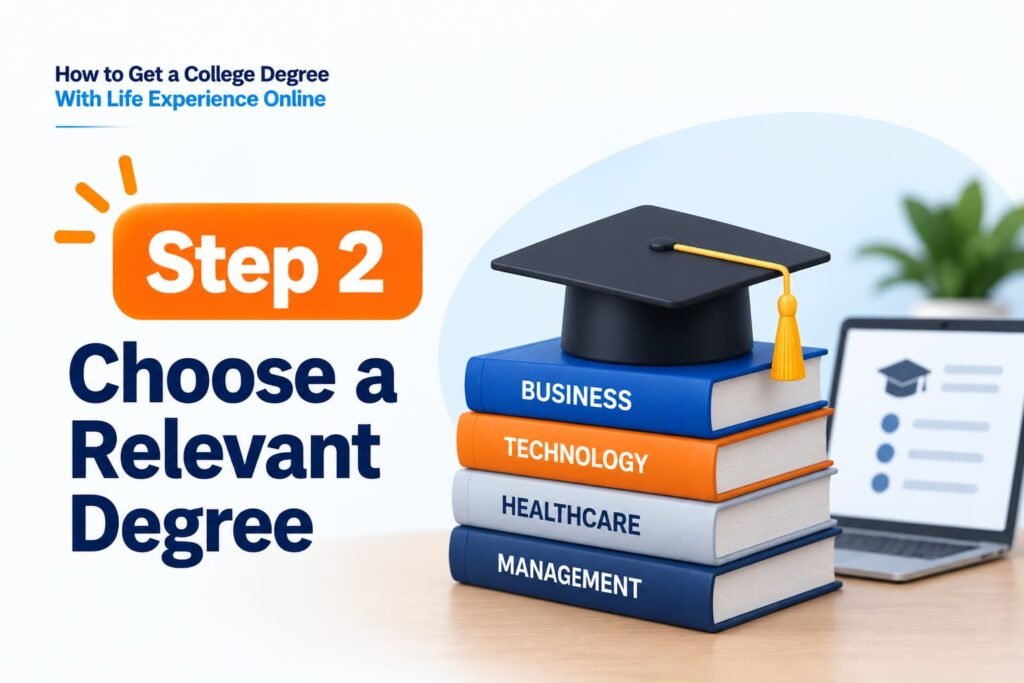
Your professional experience should have a meaningful relationship to the field of the degree.
For example, someone with extensive experience managing organizations may be better suited to a business or management degree than a degree in a completely unrelated discipline.
The purpose is to demonstrate that your experience represents substantial learning in the subject area.
3. Prepare Your Professional Portfolio
The portfolio is often one of the most important parts of the process.
Instead of simply listing your job titles, you should demonstrate what you actually learned and accomplished.
Your portfolio may include employment history, professional projects, leadership responsibilities, training, certifications, publications, reports, achievements, and other supporting evidence.
A strong portfolio focuses on learning and competencies, not merely years of employment.
For example, saying that you worked as a manager for ten years is less informative than demonstrating how you managed teams, developed strategy, controlled budgets, implemented projects, solved organizational problems, and made evidence-based decisions.
4. Submit Your Application
Once you have prepared your professional portfolio, suitability statement, and supporting documents, submit your application through your chosen institution’s online application platform.
Before submitting, carefully review your application to ensure that all information is accurate and complete.
Your professional experience should be presented clearly, with relevant responsibilities, achievements, skills, and knowledge highlighted.
An online application makes the process convenient for working professionals, allowing you to apply from anywhere without needing to visit a physical campus.
5. Undergo an Assessment
Your application is then reviewed by an assessment committee.
The committee may consist of academic scholars, industry practitioners, or other qualified evaluators.
Their role is to determine whether the evidence demonstrates the required level of knowledge, competence, and professional learning.
This assessment is what distinguishes a genuine experience-validation pathway from simply purchasing an academic credential.
6. Receive Your Degree
Once the assessment requirements have been successfully completed, the institution may issue the relevant academic documentation.
For example, UniDAIM’s VAE pathway includes a degree certificate, transcript, VAE Assessment Report, and a graduation announcement.
The exact documents and terminology vary by institution.
How UniDAIM’s VAE Pathway Works
The University of Digital and AI Management (UniDAIM) offers a VAE pathway designed specifically for experienced professionals.
Its experience-based programs are professional-focused rather than traditional classroom-based programs.
For example, its master’s pathway requires a bachelor’s degree or equivalent and at least seven years of relevant professional experience, while the doctoral pathway requires a master’s degree or equivalent and at least ten years of relevant professional experience. Both pathways require a professional portfolio and a suitability statement.
The process focuses on validating existing professional learning rather than requiring students to repeat education they may have already acquired through years of professional practice.
Learn more on the UniDAIM’s Degree by VAE page.
Before Choosing an Experience-Based Degree
Not every online institution uses the same standards, so research carefully before applying.
Check whether the institution clearly explains its assessment process, eligibility requirements, portfolio expectations, academic oversight, and the status of the resulting qualification.
You should also distinguish websites that advertise degrees simply for payment and experience without a substantive evaluation process.
Be cautious of institutions promising a degree immediately or with no meaningful evaluation.
Finally, consider whether the qualification will meet your particular goal.
Employers, professional bodies, governments, licensing organizations, and other universities may have their own recognition requirements.
Final Thoughts
Your professional experience can represent years of serious learning.
An online VAE pathway provides one way to have that learning formally assessed and, where appropriate, recognized through a degree.
The key is to look beyond the promise of a “degree based on life experience.”
A credible pathway should have clear eligibility requirements, documented evidence, structured assessment, qualified evaluators, and defined academic standards.
For experienced professionals who have built substantial expertise outside the traditional classroom, this approach can provide a more practical route toward formal higher education recognition.
SHARE