

You’ve built something meaningful. You’ve led teams, launched initiatives, influenced communities, or driven innovation in your industry.
Now you’re wondering: Should your impact be formally recognized?
An honorary degree is one way academic institutions acknowledge real-world achievement — not through exams or dissertations, but through measurable influence, leadership, and contribution.
Whether you’re early in your journey or decades into your career, understanding the difference between an Honorary Bachelor’s, Master’s, and Doctorate can help you determine which recognition aligns with your story.
Let’s break it down.
Overview of Honorary Degrees
Honorary degrees are symbolic academic distinctions awarded to individuals who have demonstrated exceptional achievement or societal impact.
You don’t earn them through coursework. Instead, you’re recognized for what you’ve already accomplished.
Here’s how the three most common levels compare:
| Feature | Honorary Bachelor’s | Honorary Master’s | Honorary Doctorate |
| Purpose | Recognizes emerging excellence and leadership potential | Recognizes advanced professional expertise and sustained contributions | Recognizes outstanding lifetime achievement and exceptional impact |
| Experience Level | 5+ years | 7+ years | 10+ years |
| Academic Requirements | No coursework required | No coursework required | No coursework or dissertation required |
| Academic Value | Symbolic | Symbolic | Symbolic |
| Title Usage | Recognition title only | Recognition title only | May use “Dr. (h.c.)” in honorary context |
The key similarity? All three are honors — not academic credentials earned through study.
Honorary Bachelor’s Degree
An Honorary Bachelor’s Degree recognizes your emerging impact. You may not have decades of experience yet, but you’ve already demonstrated initiative, innovation, and measurable results.
Unlike a traditional bachelor’s degree, you don’t sit for exams or complete credit hours. Instead, your real-world contributions speak for you.
At the University of Digital and AI Management (UniDAIM), we confer this award to celebrate innovators and changemakers contributing to digital advancement and AI awareness.

Honorary Bachelor Eligibility
Eligibility varies by institution. At UniDAIM, you may qualify if you:
- Have at least 5 years of professional, entrepreneurial, or community leadership experience.
- Demonstrate emerging excellence or innovation in your field.
- Contribute to digital transformation or AI-driven solutions.
- Show strong leadership potential aligned with future-focused education.
Honorary Bachelor Benefits
As an honoree, you may experience:
- Formal recognition of early-career achievements
- Increased professional credibility
- Stronger personal brand positioning
- Inclusion in an institutional honoree network
- Expanded visibility in corporate and entrepreneurial ecosystems
Learn More: https://unidaim-edu.us/honorary-bachelors-degree/
Honorary Master’s Degree
If you’ve moved beyond emerging leadership and are now influencing strategy, policy, or industry direction, an Honorary Master’s Degree may reflect your level of impact.
This distinction recognizes advanced expertise and sustained contribution — not potential, but proven authority.
At UniDAIM, this award honors accomplished professionals shaping digital transformation and AI-driven leadership globally.

Honorary Master Eligibility
At UniDAIM, you may qualify if you:
- Possess at least 7 years of professional experience.
- Demonstrate distinguished leadership and strategic influence.
- Contribute meaningfully to innovation, AI, or organizational transformation.
- Embody ethical, globally minded leadership.
Honorary Master Benefits
You may gain:
- Recognition of advanced professional excellence
- Elevated industry credibility
- Access to a global network of thought leaders
- Enhanced authority for advisory and keynote opportunities
- Reinforced institutional trust and executive stature
Learn More: https://unidaim-edu.us/honorary-masters-degree/
Honorary Doctorate
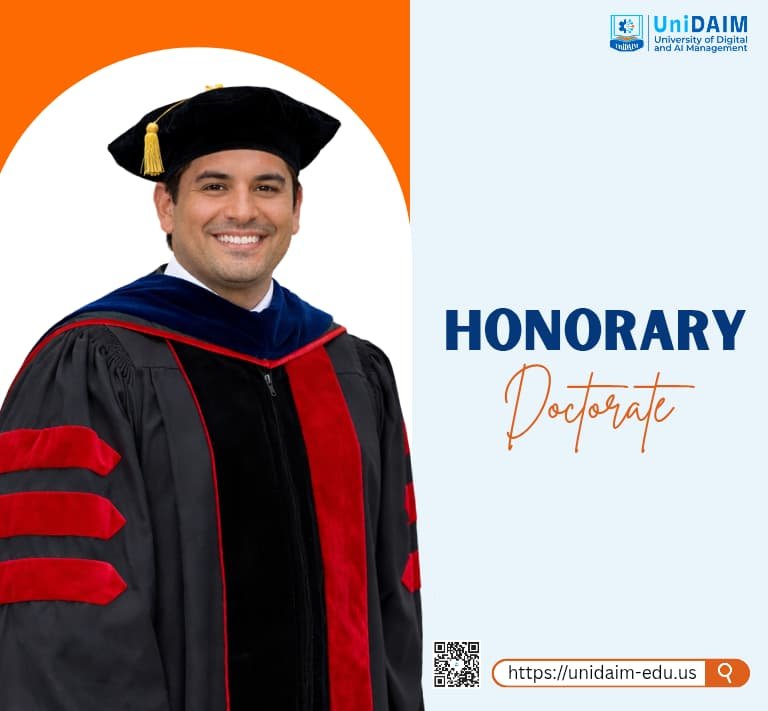
An Honorary Doctorate is the highest symbolic recognition an institution can confer. It acknowledges sustained excellence, significant societal contribution, and lasting influence.
You don’t write a dissertation. You don’t defend a thesis. Instead, your legacy becomes the basis for recognition.
At UniDAIM, this honor reflects commitment to digital innovation, artificial intelligence advancement, and future-ready leadership.
Honorary Doctorate Eligibility
You may qualify if you:
- Have at least 10 years of professional impact.
- Demonstrate exceptional achievement in business, academia, leadership, or social impact.
- Contribute significantly to digital innovation or AI advancement.
- Align with the institution’s mission of educational accessibility and forward-thinking leadership.
Honorary Doctorate Benefits
You may receive:
- Permission to use the honorary prefix Dr. (h.c.)
- Global recognition among distinguished achievers
- Invitations to participate in institutional events
- A platform for thought leadership
- Strengthened professional legacy
Title Usage
An honorary doctorate is not an earned doctorate. If you use the title, it must clearly indicate honorary status:
- Formal Writing: John Mark, Doctor of Business Administration (Honoris Causa)
- Abbreviated Form: John Mark, D.B.A. (h.c.)
- Honorary Prefix: Dr. John Mark (h.c.)
Learn More: https://unidaim-edu.us/honorary-doctorate/
Related Post: Honorary Doctorate: A Complete Guide
Honorary Degree Fees
Legitimate honorary degrees are not sold. However, many institutions invite honorees to make voluntary donations in appreciation.
At UniDAIM, all honorary degrees are conferred free of charge. As a tuition-free online university, the institution relies on donations to sustain operations. The minimum donations are:
- Honorary Bachelor: $300
- Honorary Master: $400
- Honorary Doctorate: $500
The recognition itself is never purchased — it is awarded.
Which Honorary Degree is Right For You?
Ask yourself:
- How many years of impact have you demonstrated?
- Are you being recognized for emerging leadership or lifetime contribution?
- Does your influence extend locally, nationally, or globally?
- Are you building your authority — or solidifying your legacy?
If you’re early in your influence journey, the Honorary Bachelor may align best.
If you’re shaping industries strategically, the Honorary Master fits.
If your contributions have transformed communities or sectors, the Honorary Doctorate reflects that stature.
Choose the level that matches your impact — not your ambition alone.
How to Get an Honorary Degree
While you don’t enroll in classes, you must still follow institutional processes.
Across universities, nomination systems vary. Some accept only third-party nominations; others allow self-nomination.
At UniDAIM, you may nominate yourself or someone deserving through the online platform.
Nomination Process at UniDAIM
- Nomination – Visit the appropriate award page to submit your nomination:
- Evaluation – The Honorary Award Committee reviews your nomination.
- Donation – If approved, you’ll be invited to make a minimum donation supporting tuition-free education.
- Award – Upon confirmation, the honorary degree is conferred and may be publicly announced with your consent.
FAQs
Over to You
You’ve already done the work. You’ve created impact, influenced people, and built something meaningful.
The real question isn’t whether honorary recognition matters — it’s whether your story is ready to be formally acknowledged.
An honorary degree won’t replace academic study. But it can amplify your influence, validate your contributions, and position you within a distinguished network of leaders.
So ask yourself:
Are you building your legacy quietly — or are you ready for it to be recognized?